
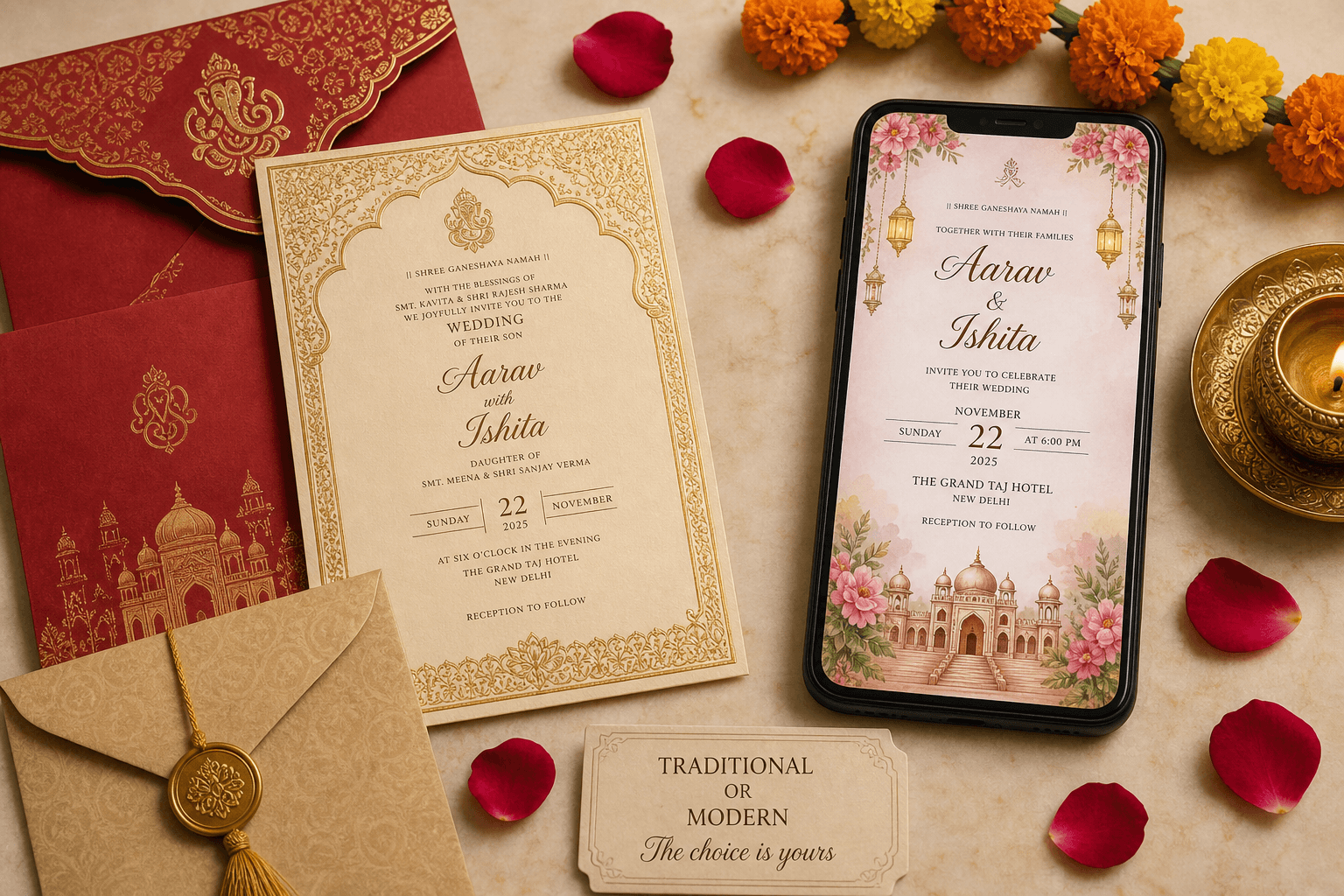
Every Indian couple planning a wedding in 2026 hits the same crossroads: print cards like your parents did, or go fully digital and risk the "log kya kahenge" conversation? The honest answer — one that WeddingWire India's data backs up — is that most families do both.
The real question is not "digital vs printed wedding invitation India" as an either-or choice. It is: who gets paper, who gets a link, and how do you keep both sides happy without doubling your budget?
This guide breaks down the hybrid strategy that works for Indian weddings in 2026 — with actual numbers, a decision matrix by guest type, and a QR code trick that bridges both worlds.
If you are still wondering whether digital invitations are worth it at all, start there. Already convinced? Read on.
The 2026 hybrid norm — why most Indian families do both
Here is the stat that reframes the debate: 54% of Indian couples still use physical wedding invitations (WeddingWire India). That is more than half. But it does not mean digital is losing — it means the smartest couples combine both formats strategically.
The hybrid approach is not a compromise. It is a recognition that Indian weddings serve different audiences with different expectations:
- Elders and VIPs (grandparents, family heads, panditji) expect a physical card handed personally — it carries izzat and ritual weight
- Extended family in other cities gets a WhatsApp link because a courier to 200 addresses is logistically painful
- Friends and colleagues prefer a digital invite they can tap and RSVP from instantly
- NRI relatives cannot receive a physical card in time anyway
The printed card becomes a gesture of respect for 50–100 people. The digital invite becomes the functional workhorse for everyone else. Together, they cover tradition and practicality without compromise.
Wondering if going fully digital feels tacky? It depends entirely on execution — a cinematic web invite feels nothing like a forwarded JPEG.
Digital vs printed: side-by-side comparison
| Feature | Printed cards | Digital invitation |
|---|---|---|
| Cost per guest | ₹40–₹300+ per card | ₹0 (one-time platform fee) |
| Delivery speed | 3–15 days (courier/hand) | Instant via WhatsApp |
| Updatable | No — reprinting required | Yes — edit anytime |
| RSVP tracking | None (phone calls) | Built-in form + dashboard |
| Multi-event details | Separate inserts needed | One scrollable page |
| Maps / navigation | Not possible | Tap-to-navigate per venue |
| Reach | Limited by logistics | Unlimited, global |
| Environmental impact | Paper, ink, courier fuel | Zero physical waste |
| Emotional / tactile value | High — keepsake quality | Moderate — depends on design |
| Elder acceptance | Universal | Growing, but not 100% |
Neither format "wins" across the board. The right answer depends on the guest, not the channel.
Decision matrix: who gets what
Use this framework to split your guest list without overthinking:
| Guest type | Printed card | Digital invite | Why |
|---|---|---|---|
| Grandparents, nana-nani, dada-dadi | ✅ | Also send link for details | Respect + functional backup |
| Parents' close friends (handed personally) | ✅ | Optional | Social ritual — hand delivery matters |
| Family in other cities | ❌ | ✅ | Courier unreliable, digital is instant |
| NRI relatives | ❌ | ✅ | Cannot deliver physically in time |
| Friends (college, work) | ❌ | ✅ | They prefer it — faster, tap-to-RSVP |
| Office colleagues | ❌ | ✅ | Professional, clean, no obligation |
| Panditji / religious figures | ✅ | Optional | Traditional respect |
| Neighbours (local) | ✅ or ❌ | ✅ | Depends on proximity and relationship |
Rule of thumb: if you would hand-deliver it with a box of sweets, print it. Everyone else gets the digital link.
QR codes on printed cards — bridge both worlds
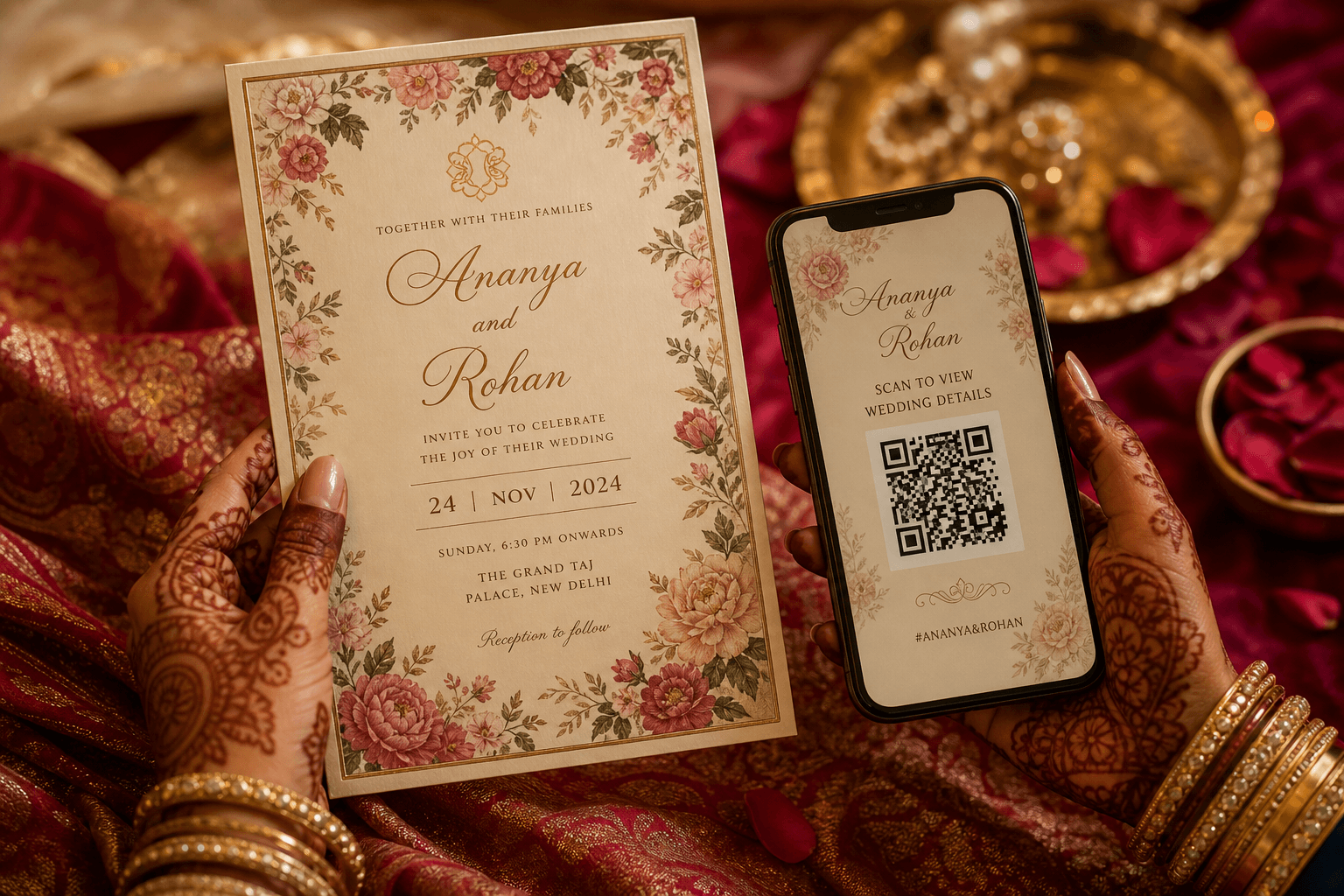
The smartest hybrid trick in 2026: print a QR code on your physical card that opens the full digital invitation. See our QR code wedding invitation guide for placement, sizing, and pre-print testing.
Here is why this works brilliantly:
- Elder gets the paper card they expect (tradition satisfied)
- They scan the QR (or their grandchild does) to see the complete timeline, maps, and RSVP form
- You get a digital RSVP even from guests who received printed cards
- Details update without reprinting — the QR always points to the latest version
How to implement:
- Create your digital invitation first (with all events, maps, RSVP)
- Generate a QR code for the invite URL
- Ask your printer to place the QR on the back of the card or inside the envelope
- Add a one-line caption: "Scan for complete details, maps & RSVP"
This eliminates the biggest problem with printed cards — they are static. The QR makes your paper card a gateway to the living, updatable invitation.
Budget math: 500 guests in INR
Let us compare three approaches for a typical Indian wedding with 500 invitees:
Option A: Fully printed
- 500 cards × ₹80 average = ₹40,000
- 50 premium box invites × ₹500 = ₹25,000
- Courier/delivery for 200 outstation = ₹8,000
- Reprints for changed details = ₹3,000
- Total: ₹76,000
Option B: Fully digital
- Premium platform with RSVP, timeline, maps = ₹2,999–₹9,999
- Distribution cost = ₹0
- Updates = ₹0
- Total: ₹3,000–₹10,000
Option C: Hybrid (recommended)
- 80 printed cards for elders/VIPs × ₹100 = ₹8,000
- 20 premium box invites × ₹500 = ₹10,000
- Local delivery = ₹1,000
- Digital invite for 400+ guests = ₹4,999
- Total: ₹24,000
The hybrid saves ₹52,000 compared to all-print — and every guest still gets a premium experience. The 400 people receiving your digital invite see a cinematic scroll-based invitation with music, countdown, and maps. That is not a downgrade. That is 2026.
For families spending ₹1,50,000+ on luxury printed cards for all guests, the hybrid saving jumps above ₹1,00,000.
Making digital invitations feel premium
The fear behind "what will people think?" is usually about quality. Elders who received a blurry JPEG in 2019 formed an opinion. A cinematic web invitation in 2026 is a completely different experience.
What makes a digital invite feel as premium as a ₹300 printed card:
- Envelope animation — the link opens with an unfolding envelope, recreating the physical ritual digitally
- Scroll-based storytelling — couple names, timeline, gallery, countdown flow like a cinematic trailer
- Typography and spacing — premium fonts, gold accents, generous whitespace (not a Canva template crammed with text)
- Background music — a soft shehnai or a curated track sets the emotional tone
- Personalized greeting — "Namaste, Rekha Aunty" hits differently than a generic blast
- WhatsApp link preview — when shared, the preview card shows a beautiful image and title, not a raw URL
The goal is simple: when Dadaji's grandson shows him the invite on a phone, his reaction should be "wah, bahut sundar" — not "yeh kya forward hai."
Explore how this looks in practice with a live demo.
Related guides
- Complete guide to digital wedding invitations in India — pillar overview with features, platforms, and costs
- Are digital wedding invitations tacky? — perception vs reality in 2026
- WhatsApp wedding invitation India — sharing etiquette, link previews, and broadcast lists
- Digital vs printed wedding invitations (global) — the same decision for non-India weddings
Frequently asked questions
Will relatives judge us for sending digital invitations?
Some might — if the invite looks like a forwarded JPEG from 2018. But a cinematic web invitation with scroll animation, music, and personalized greeting? Most relatives are impressed, not offended. The hybrid approach solves this entirely: print cards for the 50–80 people where tradition matters, send premium digital invites to everyone else. Nobody gets a "cheap" experience.
Is a digital wedding invitation cheaper than printed?
Significantly. A premium digital invitation platform costs ₹3,000–₹10,000 as a one-time fee for unlimited guests. Printed cards for 500 guests typically run ₹40,000–₹1,50,000+ depending on quality. Even the hybrid approach (80 printed + digital for the rest) saves 50–70% compared to all-print. The bigger saving is hidden: zero courier costs, zero reprints when the muhurtham shifts.
How do QR codes on printed cards work?
Your printer adds a small QR code (usually on the back or inside flap) that links to your full digital invitation. When scanned with any phone camera, it opens the complete invite with timeline, maps, dress codes, and RSVP form. This gives printed-card recipients the same functional experience as digital-only guests — maps they can tap, RSVPs they can submit, and details that update automatically.
54% still use physical invitations — should I?
That stat from WeddingWire India does not mean all 500 guests get printed cards. Most couples in that 54% use a hybrid approach — physical cards for a subset (elders, VIPs) and digital for the rest. If your family culture values hand-delivered cards for close relatives, honour that. Use digital for the 80% of guests where physical delivery adds cost without adding meaning.
Can a digital invitation look traditional enough for an Indian wedding?
Absolutely. Premium platforms offer designs with traditional motifs — mandala borders, gold foil effects, kalash icons, shehnai music, and maroon-gold colour palettes that echo the aesthetics of a printed card. The difference is that this "card" also scrolls into a full timeline, plays music, shows maps, and collects RSVPs. It looks traditional. It functions like 2026.
What about guests who do not have smartphones?
In 2026 India, smartphone penetration is above 75% and rising. For the small number of guests without smartphones (typically very elderly), the printed card handles them perfectly — that is exactly who should be on your physical list. Between a printed card and a family member showing them the digital invite on their phone, every guest is covered.