
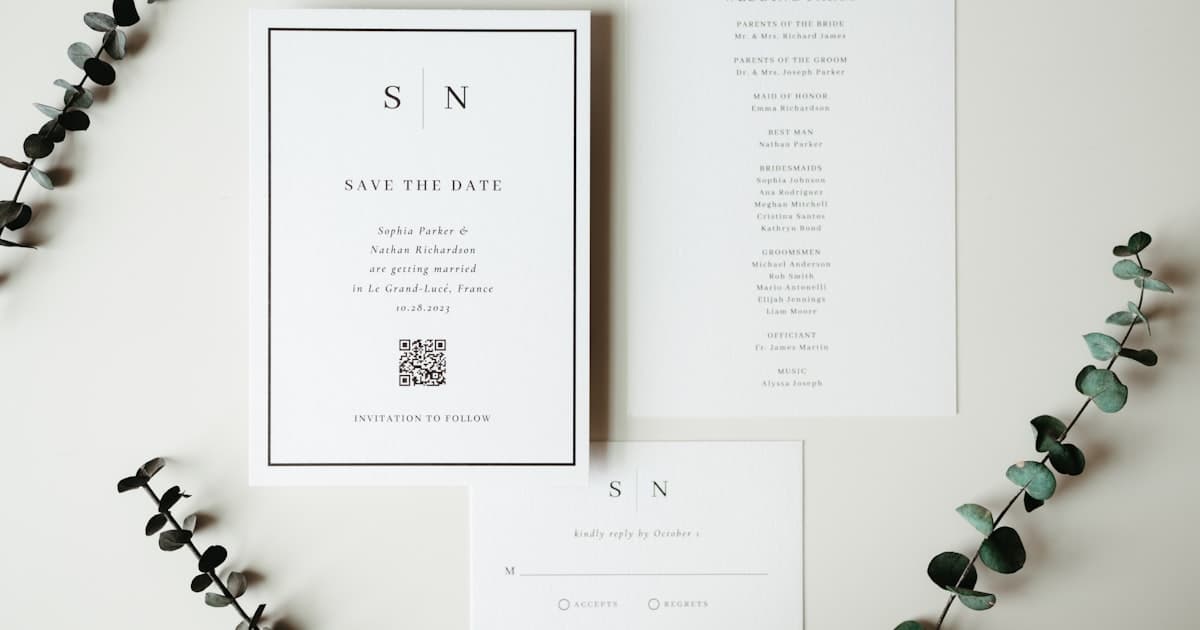
Sustainability is no longer a niche concern at weddings — it shapes venue choices, catering menus, and increasingly, how couples send invitations. If you are weighing eco-friendly wedding invitations digital options against traditional print, the conversation is more nuanced than "paper bad, pixels good."
This guide breaks down the real environmental trade-offs between printed and digital invites, looks at where paperless wedding invitations are already the norm (hello, Scandinavia), compares platforms like Greenvelope, and offers a practical hybrid path that keeps grandparents happy without filling a landfill.
For a broader overview of what digital invitations look like in 2026, start with our complete guide to digital wedding invitations.
The environmental cost of printed wedding stationery
A 200-guest wedding using traditional printed invitations generates a surprisingly long supply chain:
- Paper production — virgin card stock requires timber harvesting, water-intensive pulping, and chemical bleaching.
- Ink and coatings — foil stamping, letterpress, and UV coatings add non-recyclable layers to paper that would otherwise be compostable.
- Envelope waste — most invitations ship with an outer envelope, inner envelope, RSVP card, RSVP envelope, and inserts. That is five to seven paper items per household.
- Postage logistics — domestic and international mail means fuel for trucks, planes, and last-mile delivery.
- Reprints — venue changes or typos mean a second print run that replaces (not recycles) the originals.
The Two Sides organisation estimates that a single first-class letter generates roughly 30g of CO₂ from production to delivery. Scale that across 200 envelopes and you are looking at 6 kg of CO₂ — before counting ink, design proofs, or reprints.
None of this means printed cards are evil. But it does mean the footprint is real and cumulative — especially for large guest lists or multi-event weddings that need multiple inserts.
Digital invitations have a carbon footprint too
Here is where the conversation usually gets oversimplified. Sending a wedding invitation via link or messaging app is not carbon-zero. The servers hosting your invite consume electricity, network transmission uses energy every time a guest opens the link, and the guest's device burns power to render the page.
A single email generates an estimated 4g of CO₂ (Berners-Lee, How Bad Are Bananas?). A richer web page with images and animations might be 2–5x that. For 200 guests, that puts a digital invitation in the range of 1–4 kg of CO₂ — meaningfully lower than print, but not nothing.
The honest summary: digital invitations are lighter on the planet than printed ones for most weddings, but the gap narrows if your invite is media-heavy and hosted on fossil-fuel-powered infrastructure. The best approach is intentional choices on either side — or both.
Environmental comparison: printed vs digital
| Factor | Printed invitations | Digital invitations |
|---|---|---|
| Paper & material waste | High — 5–7 items per household | None |
| Ink & chemical coatings | Foil, UV, letterpress layers | None |
| Postage carbon | ~30g CO₂ per letter (production + delivery) | None |
| Data-centre energy | None | Small — shared hosting, brief page views |
| Reprint waste | Full second run for updates | Zero — update once, all guests see it |
| Guest-side waste | Cards often discarded after event | No physical waste |
| Estimated CO₂ (200 guests) | 6–10 kg | 1–4 kg |
| Recyclability | Partial — coated/foiled cards often non-recyclable | N/A |
| Keepsake potential | High — tangible memento | Moderate — bookmarkable link |
Neither column is a clean win across every row. But for couples prioritising sustainability, digital has the edge on waste and emissions — especially when guest counts are high and multi-event details make inserts multiply.
For a deeper side-by-side on cost, RSVP, and guest experience, see our full digital vs printed wedding invitations comparison.
Scandinavia, the UK, and the Netherlands — where paperless is already normal
The sustainable wedding invites trend is not theoretical in Northern Europe. In Sweden, Denmark, Norway, the Netherlands, and increasingly the UK, digital-first invitations are the default for most weddings — not a budget compromise.
Several factors drive this:
- Cultural pragmatism — Scandinavian design culture values minimalism and function. A single shareable link with RSVP, maps, and a timeline is considered elegant, not informal.
- High digital literacy — smartphone penetration and trust in digital communication is among the highest globally. Guests expect to receive invitations via messaging apps or email.
- Environmental consciousness — Nordic countries consistently rank at the top of sustainability indices. Couples feel social support, not judgment, for choosing paperless.
- Postal cost — sending physical mail in countries like Norway is expensive. A domestic letter costs over €2; international mail is higher. For 150 guests, postage alone can exceed €300.
In the UK, platforms like Paperless Post, Greenvelope, and newer entrants have normalised digital invitations for everything from casual parties to formal weddings. The shift accelerated post-2020 and has not reversed.
The takeaway for couples elsewhere: if you feel hesitant about going digital, know that entire countries have already made the switch — and their weddings still feel beautiful, personal, and intentional.

The hybrid approach: digital for most, printed for some
Going fully paperless works for many couples, but it is not always realistic. Some guests — grandparents, elderly relatives, family friends without smartphones — genuinely prefer a physical card they can hold.
The sustainable hybrid strategy:
- Digital link for 80–90% of your guest list — friends, colleagues, cousins, out-of-town guests. Instant delivery, built-in RSVP, zero paper waste.
- 20–50 printed cards for close family and elders — use recycled or seed paper, vegetable-based inks, and skip the inner envelope and RSVP card. Include a QR code linking to the full digital invite for RSVP and maps.
- No reprints — if details change, update the digital invite. The printed card's QR code points to the same link, so elders always see current information.
This approach saves paper where it matters most (volume) while preserving tradition where it matters most (sentiment). It is also far cheaper than all-print — see our cost breakdown for the math.
Worried that digital invitations feel impersonal? You are not alone — but the perception has shifted. See are digital wedding invitations tacky? for the honest answer.
Greenvelope vs other platforms: what to look for
Several platforms market themselves as eco-friendly digital invitation options. Here is how they compare on the features that matter for weddings:
| Feature | Greenvelope | Paperless Post | Vow Invites |
|---|---|---|---|
| Pricing model | Per-card credits | Free + premium coins | One-time fee, unlimited guests |
| Environmental focus | Core brand message | Secondary messaging | Paperless by design |
| RSVP tracking | Yes | Yes | Yes — real-time dashboard |
| Multi-event timeline | Limited | Limited | Full scrollable timeline |
| Mobile-first design | Responsive | Responsive | Built for mobile/WhatsApp |
| Link preview on share | Basic | Rich | Rich OG preview |
| Custom themes | Template library | Template library | Curated cinematic themes |
| Animations | Envelope flip | Envelope flip | Full scroll + envelope animation |
Greenvelope deserves credit for making sustainability part of the conversation early. Their per-card pricing works well for smaller weddings. For larger guest lists or multi-event weddings needing timelines, maps, and WhatsApp-optimised sharing, platforms like Vow Invites offer more depth without per-guest costs.
The environmental win is not really about which platform you choose. Any digital invitation eliminates the paper, ink, and postage chain. The choice comes down to features, design, and pricing.
Quick wins for a lower-footprint invitation
If printing: choose recycled or FSC-certified paper, skip foil stamping and UV coatings (they make cards non-recyclable), use vegetable-based inks, and replace the RSVP card with a QR code linking to a digital form.
If digital: choose a platform with optimised images and lightweight pages. Cinematic design does not require heavy files — compressed assets load faster and use less energy.
Either way: use one link for all events instead of separate invitations per function, and choose a platform with built-in RSVP so you skip the spreadsheet.
Frequently asked questions
Are digital wedding invitations actually better for the environment?
In most cases, yes. A digital invitation for 200 guests generates roughly 1–4 kg of CO₂ compared to 6–10 kg for printed stationery (paper, ink, postage, reprints). The gap widens with larger guest lists and multi-event weddings. Digital is not carbon-zero — servers, networks, and devices all use energy — but the total footprint is meaningfully lower, especially when you factor in paper waste and postal logistics.
Do guests in Europe expect digital invitations now?
In Scandinavia, the Netherlands, and increasingly the UK, digital invitations are the norm for most weddings. High smartphone adoption, postal costs, and cultural pragmatism have made paperless the default. In Southern and Eastern Europe, printed cards are still more common for formal weddings, but the shift toward digital is accelerating everywhere — particularly among couples under 40.
How do I handle older relatives who want a physical card?
Use the hybrid approach: send digital invitations to the majority of your guest list and print 20–50 cards on recycled paper for grandparents and elderly family. Include a QR code on the printed card that links to the full digital invite with RSVP, maps, and event details — see our QR code wedding invitation guide for placement and sizing. This way, elders get the tangible card they expect while you keep the environmental benefit of going mostly paperless.
Is Greenvelope the best eco-friendly invitation platform?
Greenvelope was one of the first to position itself as a sustainable digital invitation option and does it well. However, "eco-friendly" applies to any digital invitation platform — the environmental benefit comes from eliminating paper and postage, not from any one brand. Choose based on features you need: RSVP tracking, multi-event timelines, mobile design, and pricing model. Greenvelope uses per-card pricing; other platforms like Vow Invites charge a one-time fee regardless of guest count.
What is seed paper and is it worth it for wedding invitations?
Seed paper is embedded with wildflower or herb seeds — guests plant the invitation after the wedding and it grows instead of going to landfill. It is a lovely concept, but the paper is thicker, more expensive, and harder to print on with fine detail. It works best for simple designs. If sustainability is your priority and you want design flexibility, a digital invitation with a small batch of seed-paper cards for close family gives you both.
Can a digital wedding invitation feel as special as a printed one?
Absolutely — when done right. A premium digital invite opens with an animated envelope, flows through a cinematic scroll of your wedding story, and includes interactive elements like RSVP, maps, and a countdown timer. Guests experience it on their phone — the device they use most. The key is choosing a platform built for weddings (not a generic form tool) with curated typography, no watermarks, and rich link previews when shared. See a live example to compare.
Related guides
- Digital wedding invitations — complete 2026 guide (global pillar)
- Digital vs printed wedding invitations
- Are digital wedding invitations tacky?
Ready to create yours? Start building your invite →